The user is a beginner investor who has encountered gold and silver as potential assets and wants to understand the key differences between the two metals and the main ways to access them — before making any investment decision. The article guides the reader from the characteristics of both metals, through practical investment formats (physical, ETFs, mining stocks), to risks and a personal decision framework. It does not cover trading strategies or specific instrument recommendations — those topics are addressed in dedicated articles.
The user is a beginner investor who has encountered gold and silver as potential assets and wants to understand the key differences between the two metals and the main ways to access them — before making any investment decision. The article guides the reader from the characteristics of both metals, through practical investment formats (physical, ETFs, mining stocks), to risks and a personal decision framework. It does not cover trading strategies or specific instrument recommendations — those topics are addressed in dedicated articles.


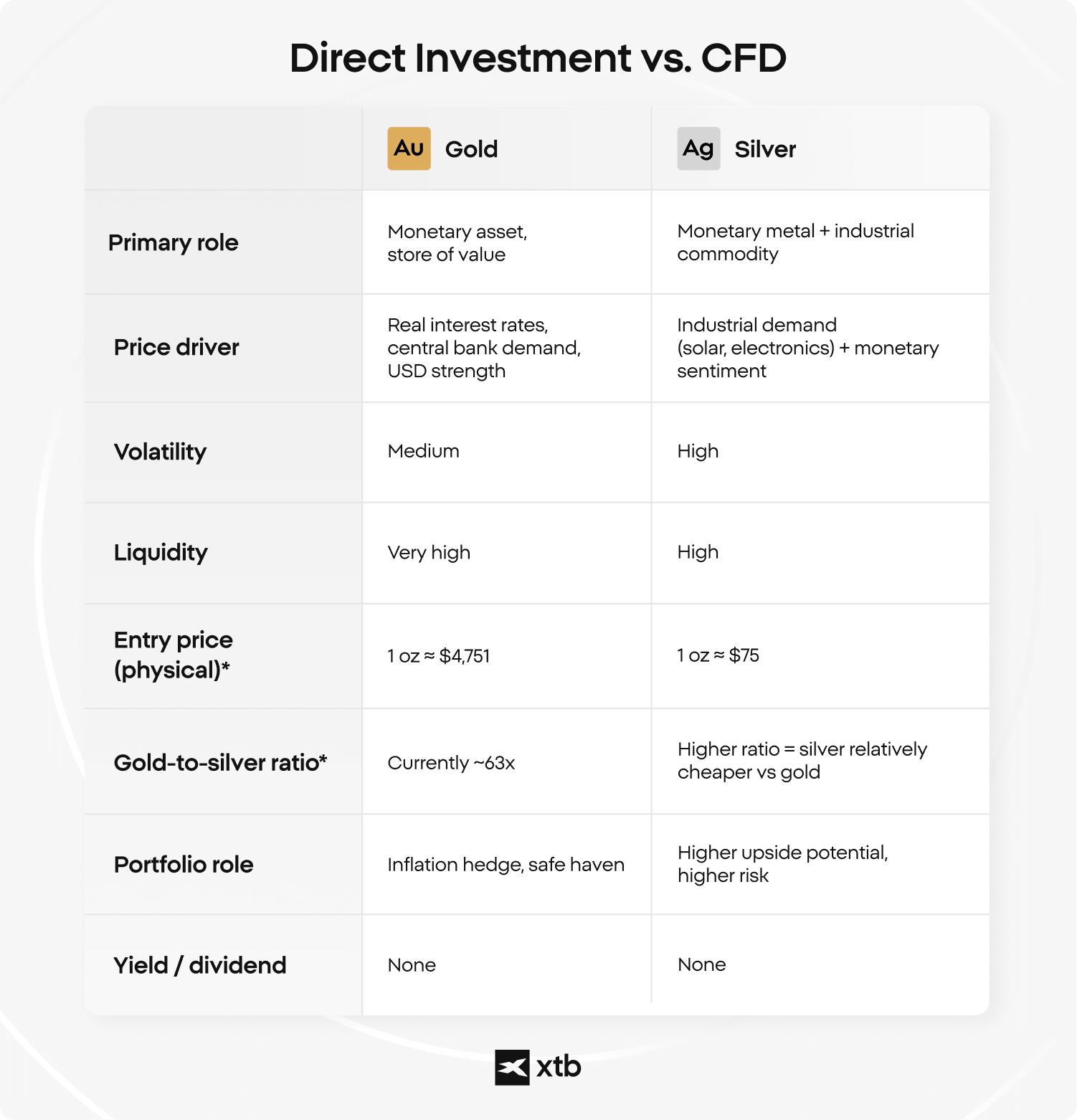
Gold is a defensive monetary asset trading at ≈$4,751/oz (May 2026), with medium volatility and a primary role as store of value. Silver is a hybrid monetary–industrial metal at ≈$75/oz, with high volatility driven by both investor demand and industrial use (electronics, solar, AI data centres). Neither metal guarantees protection against inflation or market declines — the gold-to-silver ratio (≈57:1 in May 2026) shows how the two are priced against each other. The challenge for many beginners is not choosing “the better metal,” but understanding how gold and silver actually behave, what risks they carry, and how different investment formats change the experience.
Key takeaways
- Gold is generally perceived as the more defensive precious metal, while silver tends to react more strongly to economic and industrial trends.
- Physical metals, ETFs, and mining stocks provide very different types of exposure to gold and silver, each with distinct risks and practical considerations.
- Choosing between gold and silver depends less on predicting prices and more on understanding volatility, time horizon, and investment objectives.
- Investment demand for precious metals has risen since 2020, driven by record central-bank gold purchases (over 1,000 tonnes annually in 2022–2024 per WGC), expanding fiscal deficits, and growing M2 money supply in major economies
Why Do Investors Buy Gold and Silver?
Investors buy gold and silver for three reasons: portfolio diversification (low correlation with equities — gold's 10-year correlation with S&P 500 is around 0.1), inflation hedging (gold rose ≈250% between 2010–2025 vs USD purchasing power decline), and crisis insurance (gold reached record highs during 2008 GFC and 2020 COVID shock).
Gold and silver are also linked to the idea of a “safe haven”, but they do not behave in the same way. Gold is generally seen as the more defensive metal because of its stronger monetary role, while silver is more exposed to industrial demand, which can make its price movements sharper. This difference is central to any beginner-friendly gold vs silver investment comparison.
Beginners should also understand two important limitations: precious metals can be volatile, and they do not generate income. Unlike dividend-paying stocks or interest-bearing bonds, physical gold and silver rely mainly on price changes to affect returns, which can be unpredictable over shorter periods.Gold and silver have served as money for over 5,000 years — from Egyptian gold standards (3200 BCE) to the Bretton Woods system (1944–1971). This monetary history underpins long-term demand expectations, though it does not guarantee future returns.
|
|
How Are Gold and Silver Different as Investments?
Gold and silver differ in three measurable ways: (1) price driver — gold tracks real interest rates and central-bank demand; silver tracks industrial demand (around 50% of total) plus monetary sentiment; (2) volatility — silver's annualized volatility (around 30%) is roughly 2× gold's (around 15%); (3) entry price — 1 oz of gold ≈ $4,751, 1 oz of silver ≈ $75 (May 2026). It is both an investment metal and an industrial metal used in areas such as electronics, AI data centres, solar panels, and manufacturing. This means the question “is gold or silver a better investment” has no universal answer, as each metal responds to different economic forces and suits different risk expectations. Despite different drivers, silver typically follows gold over long horizons — the 20-year price correlation between gold and silver is approximately +0.8.
For beginners, the most practical differences are volatility, liquidity, and entry price. Gold is generally more liquid globally and tends to show lower price volatility than silver. Although it can still decline in value. Silver usually has a lower price per ounce, which can make physical access easier, but its stronger link to industrial demand may lead to sharper price movements.
The gold-to-silver ratio can help explain how the two metals are priced against each other, but it should be treated only as an orientation tool, not as a trading signal or prediction method. Risk-oriented investors sometimes buy silver when the gold-to-silver ratio is historically high (e.g. above 80:1) and reduce exposure when it falls below 50:1. Important: silver is not a safe-haven asset. Roughly 50% of silver demand comes from industrial use (solar panels, electronics, EV manufacturing), making its price pro-cyclical — it tends to fall during recessions when manufacturing slows.
How Do You Choose Between Gold and Silver as a Beginner?
The choice between gold and silver depends on four practical factors: time horizon, volatility tolerance, entry budget, and investment objective. Gold (volatility around 15%) suits conservative, long-term investors prioritising capital preservation. Silver (volatility around 30%) suits investors with higher risk tolerance who want exposure to industrial and monetary demand. For beginners, the decision is often less about finding the “better” asset and more about understanding which characteristics feel more compatible with their financial situation and risk tolerance.
- Time horizon matters because precious metals can experience long periods of weak or volatile performance. Short-term expectations may not always align with how gold or silver behave over time.
- Volatility tolerance is important because silver prices have historically moved more aggressively than gold prices. Larger fluctuations can be difficult for inexperienced investors to manage emotionally.
- Entry budget may influence accessibility, especially for physical ownership. Silver usually has a lower price per ounce, while gold often requires higher upfront capital.
- Investment objective can shape expectations. Some investors focus more on stability and defensive characteristics, while others are more comfortable with assets linked more closely to economic and industrial trends.
|
|
How Can You Buy Physical Gold and Silver?
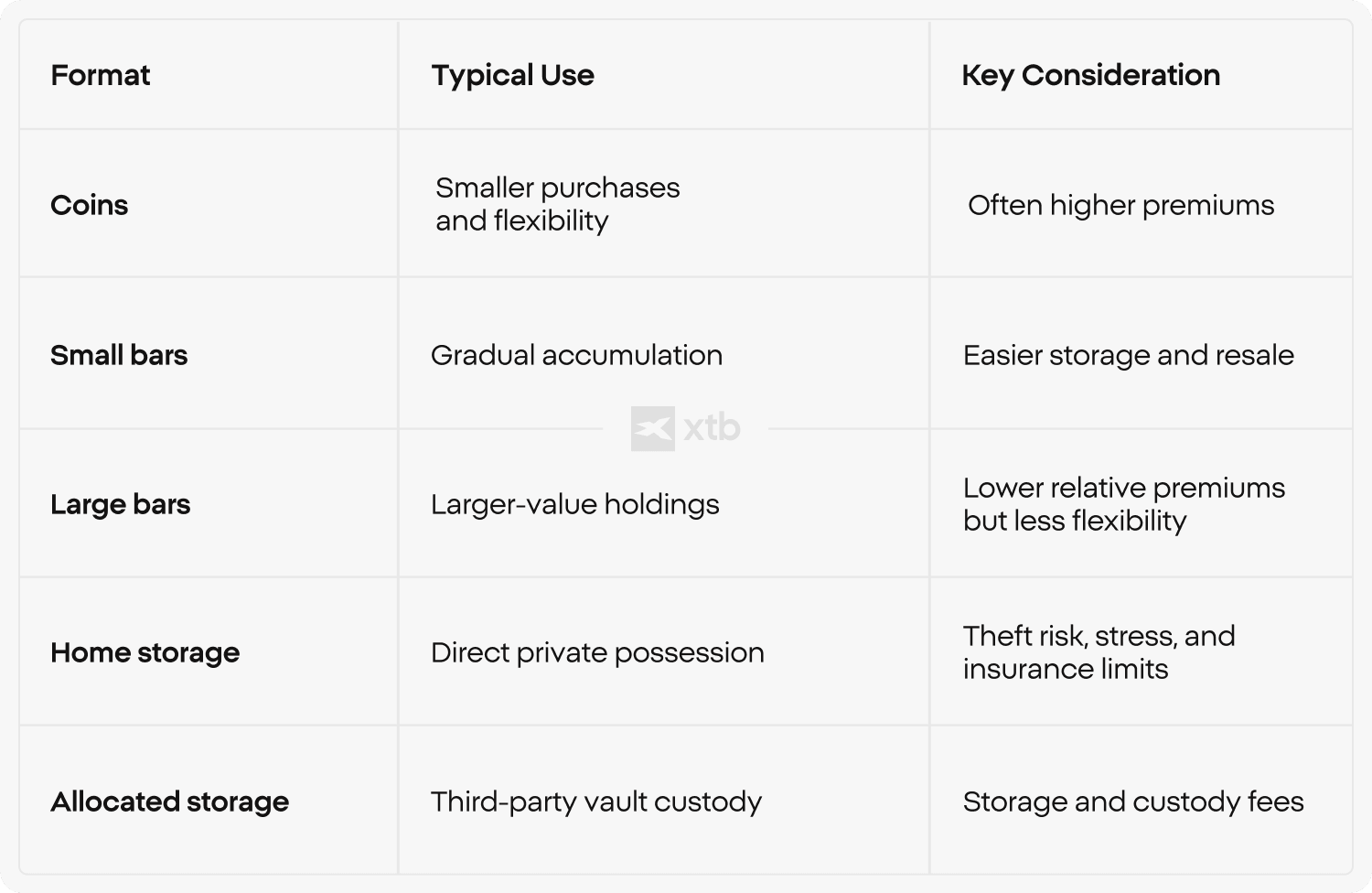
Physical gold and silver are sold in three formats: coins (e.g. American Eagle, Canadian Maple Leaf — higher premiums 5–15% over spot due to minting), small bars (1–100 g, easier resale), and large bars (1 kg–400 oz LBMA Good Delivery, lower premiums but less liquid). Buyers access them via specialized dealers, banks, and LBMA/LMBA-approved online platforms Gold and silver bullion are often sold in standardized weights and purity levels, with pricing influenced not only by the market value of the metal but also by dealer premiums, manufacturing costs, and market demand. Coins may carry higher premiums because of minting costs or collectibility, while larger bars often offer lower costs relative to weight.
Allocated vs unallocated storage Storage falls into two legal categories. Allocated storage means specific bars/coins are assigned to you (you own the metal directly; the vault holds it on your behalf). Unallocated storage means you hold a claim against the vault's general pool — cheaper, but you are an unsecured creditor if the custodian fails. Home storage adds a third option with full control but theft and insurance risk. Home storage may appear simple, but it introduces practical risks, including theft, loss, limited insurance coverage, and the stress of knowing that valuable assets are kept in a private space. For some people, this can also create everyday concerns, such as worrying about security while travelling or feeling the need to find discreet hiding places.
Before buying physical gold or silver, it helps to understand that ownership involves more than the purchase price. Physical metals may require insurance, secure storage, transportation, and verification when resold. Silver can also be less convenient to store than gold at the same market value because it takes up more space. These costs and practical responsibilities should be considered together with the metal’s price behavior, not separately from it.
How Do Gold and Silver ETFs and Funds Work?
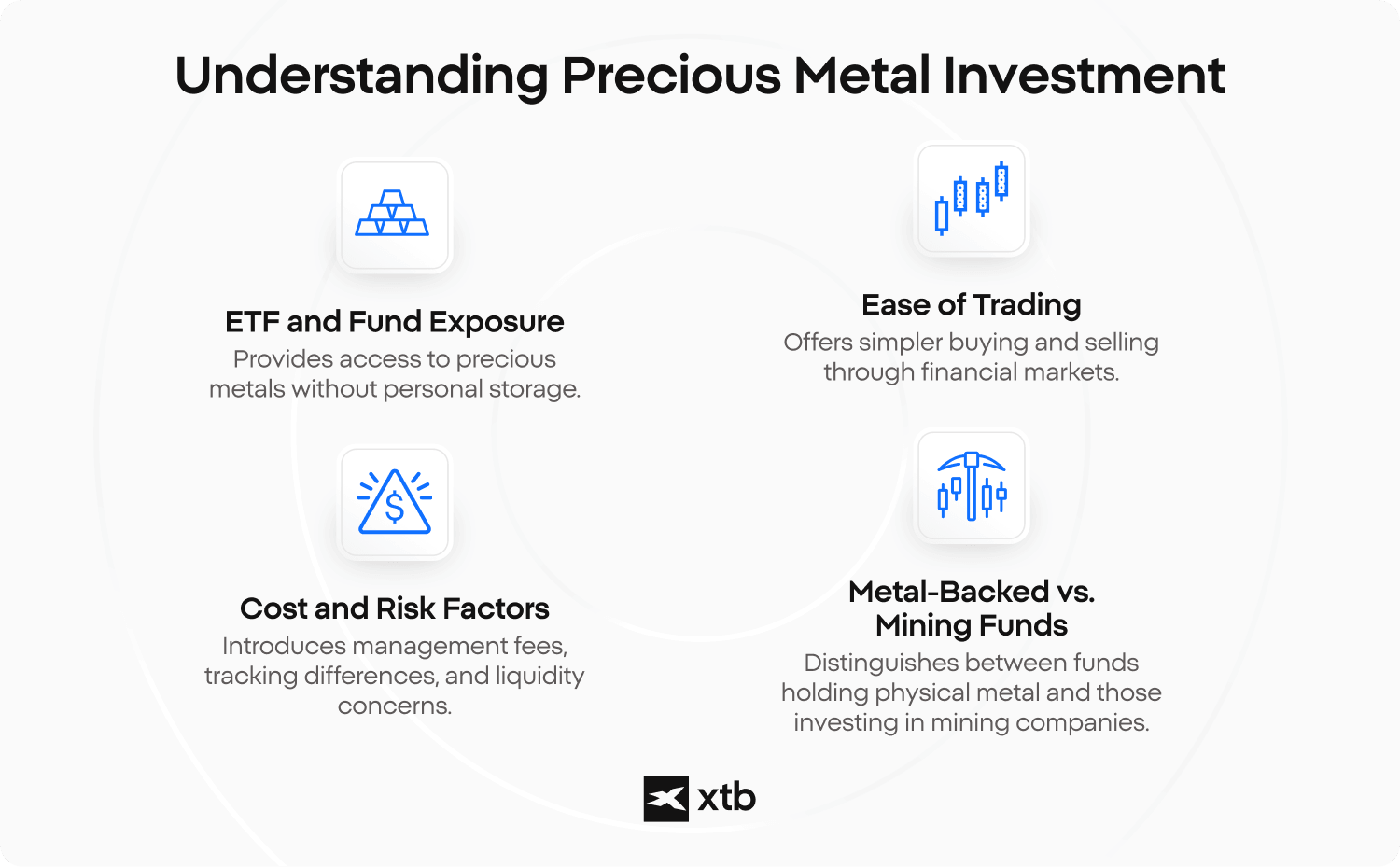
Gold and silver ETFs are exchange-traded funds that track metal prices without physical ownership. The largest examples include SPDR Gold Shares (GLD), iShares Gold Trust (IAU), and iShares Silver Trust (SLV) — all backed by physical metal stored in LBMA vaults. Expense ratios typically range from 0.17% (IAU) to 0.40% (GLD) annually. For beginners, this distinction matters because fund exposure is not always the same as owning the metal directly.
ETFs and funds are often easier to buy and sell than physical bullion because they trade through financial markets. They may also reduce practical storage concerns, but they introduce other costs and risks, such as management fees, tracking differences, liquidity conditions, and reliance on the fund structure. These features should be checked before assuming that an ETF is a simple substitute for physical ownership.
ETF prices follow the metal's spot price via NAV (Net Asset Value) but can deviate slightly — tracking error is typically <0.5% for major gold ETFs. During market stress, premiums or discounts to NAV can briefly widen.. A fund holding physical gold or silver aims to reflect the metal price more directly, while a mining fund gives exposure to companies that extract or finance production. Mining-company exposure can behave very differently because it includes equity risk, operational costs, and management decisions, not only changes in gold or silver prices.
Are Gold and Silver Mining Stocks Worth Considering?
Mining stocks (e.g. Newmont, Barrick Gold, Pan American Silver) give leveraged exposure to metal prices. A 10% rise in gold can translate to a 20–30% rise in a miner's share price if production costs remain stable — but the leverage works in both directions. Mining ETFs like GDX (gold miners) and SIL (silver miners) offer diversified exposure across multiple producers. . These companies may benefit when gold or silver prices rise, but their share prices also depend on production costs, debt levels, management decisions, and broader equity market conditions. Remember: even the best gold mining stocks are company shares first, and precious metals exposure second.
Mining stocks can amplify price moves in both directions. When metal prices rise, a miner’s profit margin may improve faster than the metal price itself, especially if production costs remain stable. When metal prices fall or costs increase, the same effect can work in reverse and put strong pressure on the company’s valuation.
Royalty and streaming companies (e.g. Franco-Nevada, Wheaton Precious Metals, Royal Gold) finance mining projects in exchange for a percentage of future production or revenue. They carry no direct operational risk (no mines to run) but retain equity, project, and geopolitical exposure to the regions where mines operate. They usually finance mining projects in exchange for a share of future revenue or metal production, so they may have less direct operating responsibility. However, they still carry equity risk, project risk, and exposure to the countries where mining assets are located.
What Are the Risks of Investing in Gold and Silver?
Gold and silver carry risks across all investment formats, but those risks appear in different ways. Physical metals involve storage, insurance, dealer spreads, and theft risk. ETFs and funds may involve management fees, tracking differences, and liquidity conditions. Mining stocks add company-specific risks, including operational problems, cost inflation, debt, and political exposure in mining regions. Price volatility is one of the main risks for both metals.
- Silver has historically been more volatile because it is influenced by both investment demand and industrial demand.
- Gold typically declines when real interest rates rise (gold pays no yield, so higher real rates increase its opportunity cost) and when the US dollar strengthens (gold is priced in USD). Example: gold fell ≈28% between August 2011 and December 2015 as the Fed signalled rate hikes.
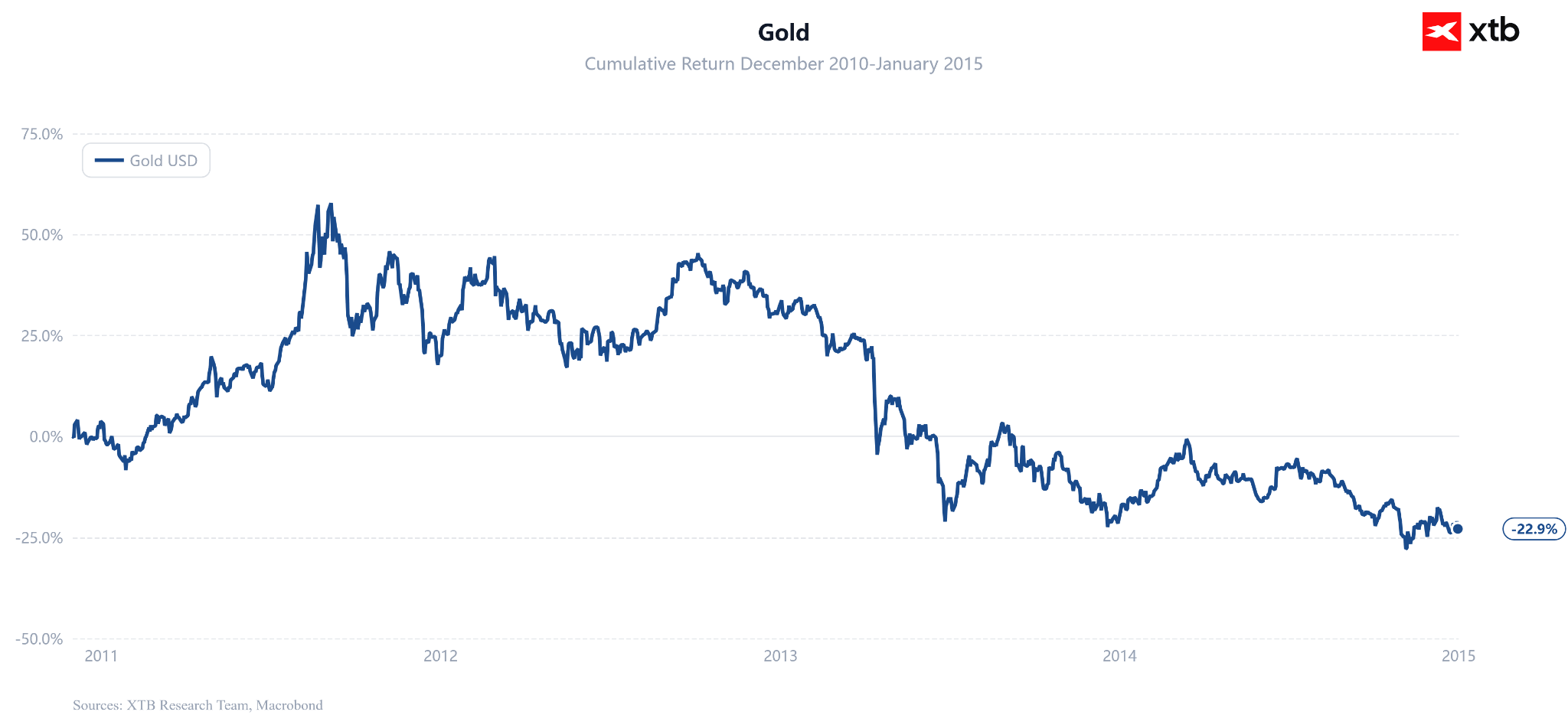
The chart shows 5-years gold performance between December 2010 and December 2015. Remember, past performance does not indicate future results.
Source: XTB Research, Macrobond
Another important limitation is the absence of regular income. Physical gold and silver do not pay dividends or interest, and metal-backed ETFs usually do not generate income from the metal itself. Should you buy gold or silver? If your primary goal is long-term capital preservation, gold may be more suitable choice - its lower volatility (around 15% vs silver's around 30%) and stronger monetary role make it the core of a precious metals portfolio.
Silver can complement gold (typical allocation: 70–80% gold, 20–30% silver) if you accept higher volatility for exposure to industrial demand. However, if you are willing to accept higher volatility and want exposure to the potential long-term growth in industrial and investment demand for silver, adding silver exposure may also be worth considering. Still, gold should remain the core component of a well-balanced precious metals portfolio.
|
|
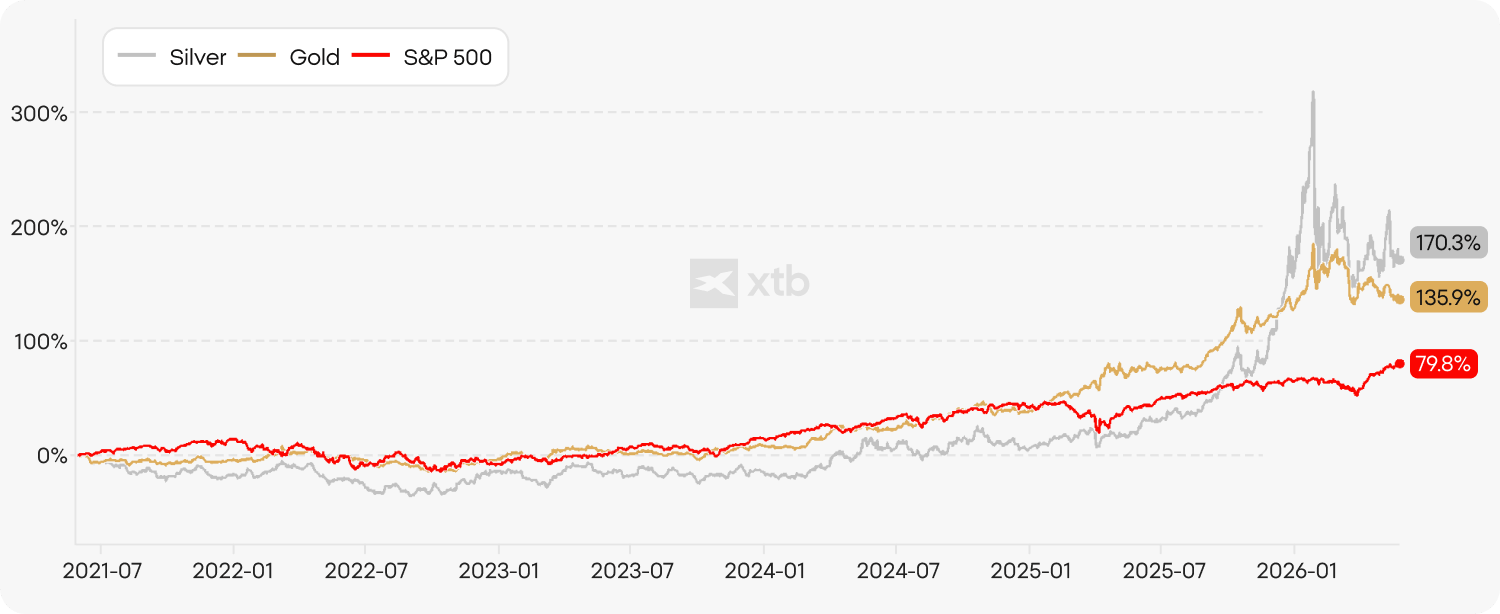
Looking at precious metals and S&P 500 index, we can clearly see that since May 2021 to May 2026, gold outperformed S&P 500 even if it lagged the index in 2010 - 2025 period. At the same time silver cumulative investment (2021 - 2026) is even better, but the metal was much more volatile. Past performance is not an indicator of future results.

FAQ
The main difference lies in how each metal behaves under changing conditions. Gold is more closely tied to financial systems and monetary factors, while silver reacts more strongly to industrial demand. This often makes silver more sensitive to economic cycles, while gold tends to be perceived as more stable.
The gold-to-silver ratio shows how many ounces of silver are needed to buy one ounce of gold. It is often used as a simple way to compare their relative pricing over time. However, it does not indicate whether one metal is undervalued or overvalued in a predictive sense.
A beginner can start by understanding the available formats rather than taking immediate action. Exposure is typically gained through physical metals, exchange-traded funds, or mining stocks, each with different characteristics and risks. The first step is to understand how each option works before choosing any approach.
Yes, both metals carry risk, primarily through price fluctuations and changing market conditions. Their behavior is influenced by multiple factors, which can lead to unexpected outcomes. The level and type of risk also depend on how exposure is obtained.
Gold and silver are often used to diversify exposure beyond traditional financial assets. They may behave differently from stocks or bonds under certain conditions, although this is not guaranteed. Their global market and limited supply also contribute to how they are perceived.
There is no universally “safest” method, as each approach involves trade-offs. Physical metals involve storage and security considerations, while financial instruments depend on market conditions and structure. Safety depends on how well the chosen method aligns with the investor’s understanding and expectations.
The choice usually depends on factors such as time horizon, tolerance for price changes, and purpose of exposure. Gold is often associated with more gradual movements, while silver tends to show stronger fluctuations. Understanding these differences helps frame the decision without simplifying it too much.
Gold is often discussed as a way to introduce an asset that behaves differently from equities or bonds. It is commonly linked to monetary conditions and long-term value perception. However, its role can vary depending on broader market dynamics.
Yes, silver generally shows higher price volatility. This is mainly due to its dual role in both industrial demand and investment markets. As a result, its price may react more sharply to economic changes.
It is important to understand that gold and silver do not generate income and their value depends on market pricing. Their behavior is not fixed and may differ from common expectations. Taking time to understand their characteristics is more useful than trying to anticipate short-term movements.